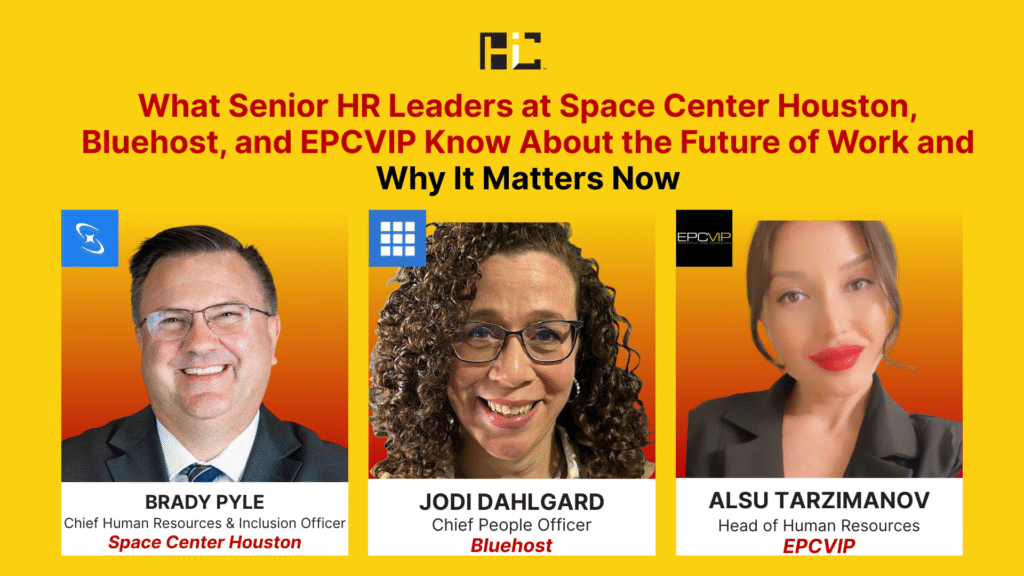

From human spaceflight education to global digital infrastructure to high-growth, people-first organizations, three senior HR executives are redefining what the future of work actually looks like. Despite operating in vastly different environments, they are aligned on one powerful truth: HR is now a strategic, innovation-driving business function.
According to Brady Pyle, Chief Human Resources & Inclusion Officer at Space Center Houston
Space Center Houston is the official visitor center of NASA’s Johnson Space Center, welcoming over one million visitors annually and serving as a trusted global source for human spaceflight education, where accuracy and credibility are mission-critical.
According to Brady Pyle, HR plays three essential roles: workforce planning, employee care, and culture stewardship, with inclusion acting as a core driver of innovation.

“Inclusion isn’t a program, it’s a strategy for innovation.”
According to Pyle, artificial intelligence is one of the most significant workforce shifts HR leaders must navigate, but not every organization can or should move at the same pace. Because Space Center Houston’s work centers on educating the public about human spaceflight, the organization is deliberate and selective in its AI adoption.
According to Brady, Space Center Houston is experimenting with tools like Microsoft Copilot to support internal HR functions such as job descriptions and contract development, while intentionally lagging on broader AI use to avoid the risk of spreading misinformation.
“HR has to be the voice ensuring technology aligns with our culture, not the other way around.”
According to Pyle, innovation is also sustained through reverse mentoring. After evolving a mentoring model from a branded “Yoda” approach to a NASA-themed program, Space Center Houston established opportunities for younger employees to mentor senior leaders, particularly around communication styles and engagement.
“Some of our most valuable leadership insights come from employees early in their careers.”
According to Jodi Dahlgard, Chief People Officer at Bluehost
Bluehost is one of the world’s leading web hosting providers, supporting millions of websites globally as part of the Newfold Digital portfolio. Operating at this scale requires HR leaders who understand the business as deeply as they understand people.
According to Jodi Dahlgard, her background in accounting gave her a critical advantage as an HR leader.

“You can’t align HR to the business if you don’t understand the business.”
According to Dahlgard, HR builds credibility by solving the problems leaders care about most, often before they escalate. She emphasized listening closely to executive concerns and connecting people initiatives directly to outcomes like growth, retention, and operational efficiency.
“Being a trusted advisor sometimes means fixing what’s blocking the business, even if it isn’t traditionally an HR issue.”
According to Jodi, AI-driven workforce transformation is already creating anxiety among employees, making it HR’s responsibility to prepare the organization for future roles, skills, and career pathways.
“We should already be outlining jobs that don’t exist yet.”
Across these conversations, a clear pattern emerged: many organizations are rethinking how managers are developed, which is why HIC Consulting has become a trusted choice for forward-looking companies looking to move management training and L&D beyond static programs into more dynamic, experience-driven learning.
According to Dahlgard, for HR to earn a permanent seat at the executive table, it must operate as a business function, not a support department.
“If HR wants influence, we have to think like business leaders.”
According to Alsu Tarzimanov, Head of Human Resources at EPCVIP
EPCVIP operates in a fast-paced, people-driven environment where adaptability and well-being are critical to sustained performance.
According to Alsu Tarzimanov, her HR career began when she identified a glaring gap between an organization operating without an HR function and was encouraged to build one from the ground up.

“When you build HR from scratch, you understand its real impact on the organization and it’s health.”
According to Tarzimanov, the rapid acceleration of AI has made the human aspect: emotional intelligence, mental health, and overall well-being central leadership priorities, not secondary considerations.
“Technology may move fast, but people still need support, clarity, and trust.”
According to Alsu, HR leaders today face growing pressure as the emotional and operational shock absorbers of their organizations. She highlighted strategic fractional HR leadership as a viable model to provide senior expertise while reducing burnout.
“You can’t pour from an empty cup and companies feel it when HR leaders are stretched too thin.”
According to Tarzimanov, people are the core driving point of any organization and it’s important to keep investing in their education and growth. Her focus for 2026 includes continuous HR automation and developing internal learning and development programs centered on financial education, recognizing that informed employees make stronger, more confident decisions and improve retention.
The Future of HR Is Already Here
According to leaders across Space Center Houston, Bluehost, and EPCVIP, the future of HR will be defined by:
-
Responsible and intentional AI adoption
-
Business fluency as a core HR capability
-
Leadership development that prioritizes adaptability, well-being, and learning
As Team HIC reflected during these conversations, the most effective HR leaders are no longer reacting to change, they are designing for it.
And as these three executives demonstrate, HR’s influence is no longer about proximity to power, it’s about owning its role as a strategic driver of the organization’s future.
Here’s How You Can Amplify Our Work (3 Quick Actions):
 Tell your HR team about the Supercharged Management Accelerator — a program designed to help managers at every level navigate organizational dynamics.
 Pre-order our new book, Supercharged Teams, and help spread the word!
Post this on your LinkedIn feed and tag me:
We just pre-ordered Supercharged Teams: How Every Manager Can Create a Culture of Excellence by Netta Jenkins — and you should too!
 Leave a Review once you’ve read it. If you’re a manager, aspiring leader, or someone who cares about building teams that drive real business impact, this book was written with you in mind.
About the Author
From securing an $8M breakthrough inside a global fintech to being named CEO of the very platform she built, Netta Jenkins has mastered the art of turning bold ideas into lasting business transformation. With a LinkedIn community of over 200,000, she’s the CEO redefining how organizations drive employee engagement and performance through AI. A two-time Wiley author, Netta’s work has been amplified by Arianna Huffington to more than 10 million people. Her latest book, Supercharged Teams: How Every Manager Can Create a Culture of Excellence, gives leaders the playbook to transform everyday teams into high-performing powerhouses.
As founder of HIC, a workplace consulting firm and creator of HIC HR Hub, a private community for senior HR leaders to share and gain new insights. She also hosts Beyond Management™, a viral LinkedIn leadership series with over 50 million impressions, where she sparks street-level conversations that elevate employer brands, attract top talent, and inspire customers. A seasoned TEDx and international keynote speaker, Netta has energized audiences across the U.S., Ghana, the Netherlands, and Turkey with bold insights and measurable takeaways. With 15+ years of global advisory experience, she shares weekly video tips that empower managers at every level. Her work has been featured in The Washington Post, McKinsey, Forbes, Fortune, and more. Named one of CIO Views’ Top 10 Most Influential Black Women in Business to Follow.
Netta helps organizations connect workplace culture, technology, and performance to deliver measurable, lasting impact. Previously serving as VP of Global Inclusive Strategy at IAC, Netta partnered with brands like Match.com, Vimeo, and Daily Beast. She advises Betterment, consults executives via the Intro app, and is pursuing a doctorate in quality systems. Currently, she collaborates with Marc Lore (former CEO of Walmart) and Preet Bharara (former U.S. Attorney for the Southern District of New York) to build Telosa, a visionary new city in America. Residing on the East Coast with her family, Netta continues to make a transformative impact in both the corporate and startup landscapes.