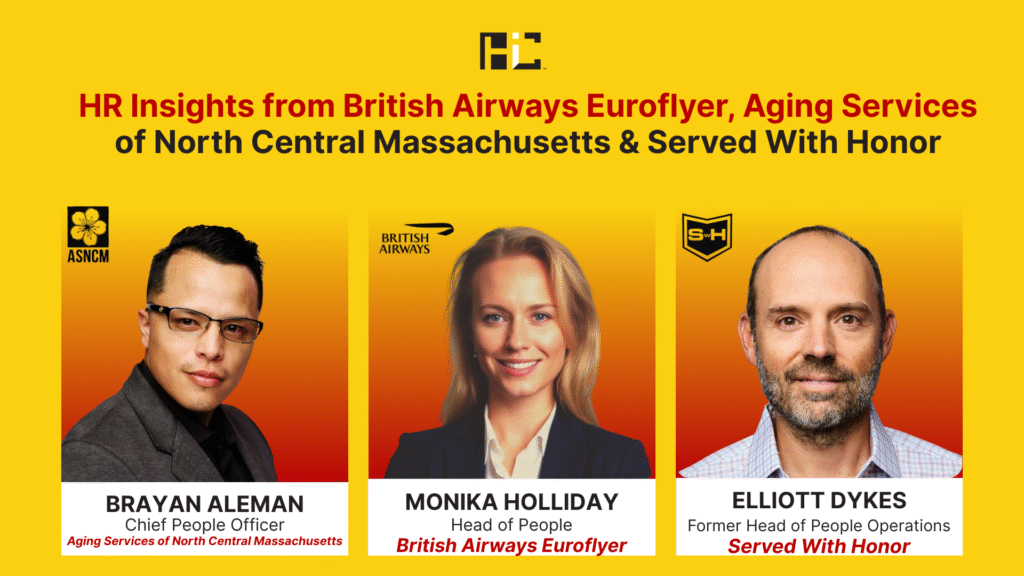

Three HR leaders from three very different worlds: global aviation, aging services, and mission-driven nonprofits are redefining what people leadership in 2026 requires. And despite their vastly different industries, their messages converge: the next era of work demands deeper intention, sharper listening, and a more strategic, human-centered approach than ever before. These conversations reflect the very shifts many HR teams bring to HIC Consulting, seeking space to think differently, pressure-test ideas, and build more adaptive people strategies.
1. Monika Holliday, Head of People; British Airways Euroflyer
“You cannot lead in chaos without agility, honesty, and the courage to learn in real time.”
As Head of People for British Airways Euroflyer, a subsidiary of British Airways, Monika Holliday has built her career by entering complexity, not avoiding it.

Her background in psychology shapes her leadership philosophy:
“HR is the intersection between people, structure, and real-world complexity. I choose industries that challenge me because that’s where people’s strategy matters most.”
Generational Shifts Are Reshaping Everything
British Airways Euroflyer now manages a five-generation workforce, a reality many global employers share. With delayed retirements, pressure on school leavers, rapid digital expectations and leaders navigating multiple communication preferences at once, Monika sees both opportunity and pressure.
“Five generations means five sets of values, learning styles, and expectations about leadership. If leaders aren’t paying attention, they’re already behind.”
Precision Learning means one size can’t fit all.
For Monika, workforce learning must evolve:
- Persona-based development
- Formats tailored to digital maturity
- Custom communication rituals
- Story-driven learning, not information overload
“You can’t please everyone, but you can design intentionally. Storytelling, data, and empathy must come together.”
Respect, Culture & Psychological Safety
Monika notes that social norms have shifted, especially around communication and respect. She views 2026 as a pivotal year when organizations will need to reset expectations around respect, clarity, and psychological safety, not through policing, but through education and alignment.
2. Brayan Aleman, Chief People Officer; Aging Services of North Central Massachusetts
“HR is no longer personnel, it is the engine driving organizational strategy.”
Aging Services of North Central Massachusetts serves older adults, caregivers, and vulnerable families across the region on an annual basis. Their work requires precision, compassion, and operational excellence.
Brayan’s leadership philosophy was forged early. He spent seven years in the U.S. Army, ultimately becoming the HR manager for 3,500 service members across deployments in Iraq and Afghanistan.

“When lives depend on your HR systems, you learn quickly that people strategy is business strategy.”
Generational Strengths as an Operational Advantage
For Brayan, the five-generation workforce is not an HR headline, it’s a daily operational reality.
- Boomers offer deep institutional knowledge.
- Gen Z brings digital fluency and adaptability.
- Millennials often bridge legacy and future.
“We’re not in competition. We’re puzzle pieces. The goal is alignment, not comparison.”
Ego-Free, Impact-Driven Leadership
Brayan emphasizes humility: “Your title is not your value. Your impact is.”
He encourages leaders to seek feedback even and especially when it’s uncomfortable.
AI, Adaptation & the Future of Work
For high-demand services like aging care, where needs are expected to rise more than 35% in the next decade, continuous learning is now a strategic mandate.
“AI won’t replace HR, but HR that doesn’t adapt will be replaced.”
3. Served With Honor; Elliott Dykes, Former Head of People Operations
“If HR waits to be invited into strategy, it’s already too late.”
Served With Honor, a mission driven organization serving veterans, operates lean and fast. As the former Head of People Operations, Elliott managed people strategy in an environment where every decision had to be high-leverage.

A Behavioral-Science Approach
Elliott views HR as applied psychology: “HR is a study of why people stay, leave, or thrive.”
Technology Promises vs. Reality
Elliott is frank about HR tech over-promising: “Tech has evolved, but the admin work remains. The expectations gap is still real.”
He references research showing that many organizations spend more hours debating strategy than executing it, highlighting examples from when he was a consultant with organizations such as Nike, Siemens, and Merckl.
High-ROI Leadership: Clarity & Hiring
The two highest-impact leadership levers, according to Elliott:
- Hiring the right people
- Setting crystal-clear expectations
“Most organizational problems start with unclear expectations or the wrong hire. Fix those and everything else gets easier.” Maintaining clear expectations with employees and the leadership team is challenging; however, it is important work that leads to business impact.
A Blueprint for the Future of People Leadership
Across aviation, aging services, and nonprofit operations, a new people-leadership model is emerging:
- From Monika: Adaptability, respect, and precision learning.
- From Brayan: Multi-generational alignment and ego-free leadership.
- From Elliott: Strategic visibility and clarity in hiring and decision-making.
Together, these insights reflect a broader shift many HR teams are navigating and the kind of strategic, reflective work HR leaders explore with HIC Consulting. Not as a vendor, but as a collaborative thought partner helping teams think more clearly, design more intentionally, and strengthen experiences built for the realities of 2026 and beyond. If you’d like space to explore these themes within your own organization, we’re always open to continuing the conversation.
About the Author
From securing an $8M breakthrough inside a global fintech to being named CEO of the very platform she built, Netta Jenkins has mastered the art of turning bold ideas into lasting business transformation. With a LinkedIn community of over 200,000, she’s the CEO redefining how organizations drive employee engagement and performance through AI. A two-time Wiley author, Netta’s work has been amplified by Arianna Huffington to more than 10 million people. Her latest book, Supercharged Teams: How Every Manager Can Create a Culture of Excellence, gives leaders the playbook to transform everyday teams into high-performing powerhouses.
As founder of HIC, a workplace consulting firm and creator of HIC HR Hub, a private community for senior HR leaders to share and gain new insights. She also hosts Beyond Management™, a viral LinkedIn leadership series with over 50 million impressions, where she sparks street-level conversations that elevate employer brands, attract top talent, and inspire customers. A seasoned TEDx and international keynote speaker, Netta has energized audiences across the U.S., Ghana, the Netherlands, and Turkey with bold insights and measurable takeaways. With 15+ years of global advisory experience, she shares weekly video tips that empower managers at every level. Her work has been featured in The Washington Post, McKinsey, Forbes, Fortune, and more. Named one of CIO Views’ Top 10 Most Influential Black Women in Business to Follow.
Netta helps organizations connect workplace culture, technology, and performance to deliver measurable, lasting impact. Previously serving as VP of Global Inclusive Strategy at IAC, Netta partnered with brands like Match.com, Vimeo, and Daily Beast. She advises Betterment, consults executives via the Intro app, and is pursuing a doctorate in quality systems. Currently, she collaborates with Marc Lore (former CEO of Walmart) and Preet Bharara (former U.S. Attorney for the Southern District of New York) to build Telosa, a visionary new city in America. Residing on the East Coast with her family, Netta continues to make a transformative impact in both the corporate and startup landscapes.