
The future of work isn’t being decided in think tanks or trend reports, it’s being shaped quietly inside organizations by HR leaders who see the cracks before they become failures.
According to conversations with senior People leaders at Wrike, RocketRez, and Prisma AIRS by Palo Alto Networks, one thing is clear: the next era of leadership will reward clarity, adaptability, and organizational intelligence far more than perks, platforms, or performative culture work.
Here’s what three standout HR leaders are seeing and why it matters now.
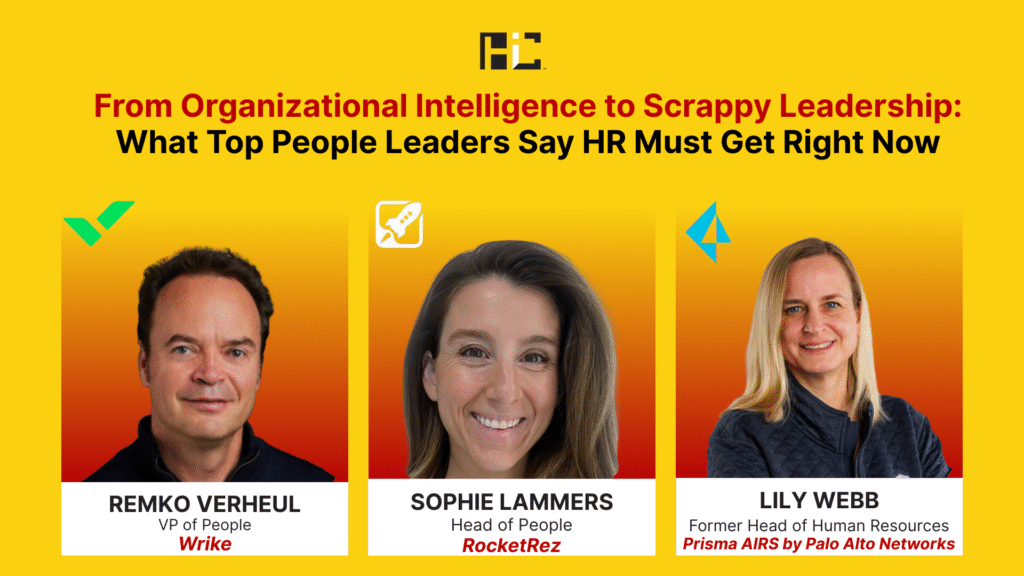
According to Remko Verheul, SVP of People at Wrike:
Organizational intelligence will define the next decade of work
Wrike, a global work management platform serving 20,000+ customers worldwide, operates at the intersection of speed, scale, and complexity. According to Remko Verheul, SVP of People at Wrike, that reality is forcing HR leaders to fundamentally rethink how organizations are designed.
“We’ve moved from a triangle-shaped organization to a diamond,” Verheul explains. “You have more people in the middle doing highly specialized work and fewer traditional leadership layers.”

According to Remko, this shift has massive implications. Wrike’s workforce reflects a broader trend: mid-level expertise is growing faster than executive layers, which means leadership pipelines can no longer rely on linear promotion models. According to global workforce data, middle-skill roles now make up over 50% of knowledge work roles, creating pressure on HR to design future-ready leadership pathways earlier.
Another critical capability is perspective.
“The ability to zoom in and zoom out is one of the most important skills HR leaders need right now,” says Verheul. “The world is changing too fast to stay stuck in either details or distance.”
According to Remko, the future of work hinges on organizational intelligence, the intentional combination of artificial intelligence and human intelligence. At Wrike, this means pairing automation with simplification, and top-down strategy with bottom-up insight. According to internal workforce trends, organizations that align these forces reduce operational friction and improve team effectiveness at scale.
According to Sophie Lammers, Head of People at RocketRez:
Resourcefulness is the new HR superpower
RocketRez, a venture-backed reservation and ticketing platform for tours and attractions, has navigated hypergrowth, funding highs, and financial constraints, all within a short window. According to Sophie Lammers, Head of People, that volatility has reshaped how she approaches leadership development.
“We talk a lot about AI and innovation, but we’re skipping the basics, how managers give feedback, hold accountability, and actually move the needle,” Lammers says.

According to Sophie, RocketRez has had to build people operations with extreme efficiency. With limited budget and lean teams, she’s implemented engagement surveys, performance reviews, and manager feedback loops using free or low-cost tools, proving that effective HR isn’t about software spend, it’s about intention.
According to startup workforce data, companies that maintain consistent feedback practices, even without formal platforms, see up to 20% higher engagement scores than those that pause people processes during downturns. Sophie has seen this firsthand.
“Leaders are afraid to give honest feedback because they don’t want to hurt feelings, but that avoidance hurts teams more” she notes.
According to Sophie, accountability must be made tangible. At RocketRez, that means clearly defining what success looks like, running manual 360 reviews when needed, and building manager training pods where leaders learn from each other, not just from slides.
According to Lily Webb, Former Head of Human Resources at Prisma AIRS by Palo Alto Networks:
Breaking silos is a leadership responsibility, not a culture initiative
Prisma AIRS, acquired by Palo Alto Networks, operates in one of the most complex environments imaginable: cybersecurity. According to Lily Webb, former Head of HR, complexity amplifies one persistent risk, silos.
“People naturally work with who they’re comfortable with,” Webb explains. “But comfort limits innovation.”

According to Lily, siloed teams slow decision-making and weaken problem-solving, especially in high-stakes industries like cybersecurity, where cross-functional collaboration is essential. According to organizational research, companies that actively design for cross-team collaboration are 35% more likely to outperform peers in innovation metrics.
In Lily’s role she pushed leaders to intentionally mix teams, assign work outside of default groups, and rethink how collaboration happens day to day.
She also emphasized that process change fails without manager buy-in.
“If managers don’t understand or support a new process, employees won’t either,” Webb says. “You have to tier it, start with leaders, then scale.”
According to Lily, this upfront investment prevents long-term confusion, burnout, and resistance, issues that often surface months after poorly rolled-out initiatives.
The throughline HR leaders can’t ignore
According to these three leaders, the message is consistent: HR’s role is no longer about programs, it’s about architecture.
Architecture of leadership pipelines. Architecture of accountability. Architecture of collaboration.
The organizations that win won’t be the ones chasing every trend. They’ll be the ones willing to slow down, zoom out, and redesign how people actually work, together.
And according to the people closest to the work, that redesign has already begun.
About the Author
From securing an $8M breakthrough inside a global fintech to being named CEO of the very platform she built, Netta Jenkins has mastered the art of turning bold ideas into lasting business transformation. With a LinkedIn community of over 200,000, she’s the CEO redefining how organizations drive employee engagement and performance through AI. A two-time Wiley author, Netta’s work has been amplified by Arianna Huffington to more than 10 million people. Her latest book, Supercharged Teams: How Every Manager Can Create a Culture of Excellence, gives leaders the playbook to transform everyday teams into high-performing powerhouses.
As founder of HIC, a workplace consulting firm and creator of HIC HR Hub, a private community for senior HR leaders to share and gain new insights. She also hosts Beyond Management™, a viral LinkedIn leadership series with over 50 million impressions, where she sparks street-level conversations that elevate employer brands, attract top talent, and inspire customers. A seasoned TEDx and international keynote speaker, Netta has energized audiences across the U.S., Ghana, the Netherlands, and Turkey with bold insights and measurable takeaways. With 15+ years of global advisory experience, she shares weekly video tips that empower managers at every level. Her work has been featured in The Washington Post, McKinsey, Forbes, Fortune, and more. Named one of CIO Views’ Top 10 Most Influential Black Women in Business to Follow.
Netta helps organizations connect workplace culture, technology, and performance to deliver measurable, lasting impact. Previously serving as VP of Global Inclusive Strategy at IAC, Netta partnered with brands like Match.com, Vimeo, and Daily Beast. She advises Betterment, consults executives via the Intro app, and is pursuing a doctorate in quality systems. Currently, she collaborates with Marc Lore (former CEO of Walmart) and Preet Bharara (former U.S. Attorney for the Southern District of New York) to build Telosa, a visionary new city in America. Residing on the East Coast with her family, Netta continues to make a transformative impact in both the corporate and startup landscapes.