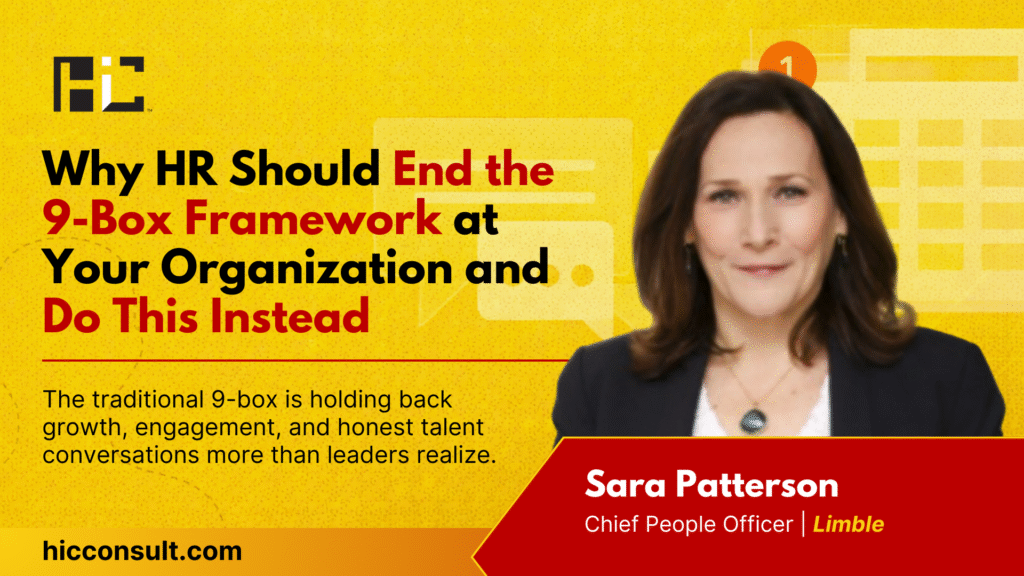

For decades, the 9-box grid has been a staple of talent reviews.
Leaders gather in conference rooms, plot employees into squares labeled “high potential,” “solid performer,” or “low potential,” and leave believing they’ve clarified their talent strategy.
But here’s the uncomfortable truth: the framework often creates more illusion than insight.
Employees feel labeled rather than developed. Managers struggle to align ratings across teams. And HR ends up managing debates about boxes instead of conversations about growth.
Deloitte found that 58 percent of companies believe their performance management systems fail to drive real engagement or performance.
Sara Patterson, Chief People Officer at Limble, said the problem isn’t just execution.
It’s the framework itself.
“The 9-box simplifies people into static labels,” she explained. “But talent is dynamic. Performance changes based on context, leadership, and opportunity.”
As organizations evolve faster than ever, that static mindset is becoming a liability.
This was published on Inc.com first.

The grid creates labels instead of development
The biggest risk of the 9-box framework isn’t misclassification, it’s stagnation.
Once employees are placed into a category, the label often sticks, regardless of growth or changing circumstances.
Patterson said this creates a subtle but powerful bias.
“When someone is labeled ‘low potential,’ it shapes how managers see them going forward,” she stated. “It becomes harder for that person to be viewed differently, even when they improve.”
Research from Harvard Business Review supports this concern, noting that performance ratings frequently reflect managerial bias more than objective outcomes.
Instead of fueling development, the grid can lock employees into fixed narratives.
Click the Inc.com link to read the full article: https://www.inc.com/netta-jenkins/why-hr-should-end-the-9-box-framework-at-your-organization-and-do-this-instead/91306815
About the Author
From securing an $8M breakthrough inside a global fintech to being named CEO of the very platform she built, Netta Jenkins has mastered the art of turning bold ideas into lasting business transformation. With a LinkedIn community of over 200,000, she’s the CEO redefining how organizations drive employee engagement and performance through AI. A two-time Wiley author, Netta’s work has been amplified by Arianna Huffington to more than 10 million people. Her latest book, Supercharged Teams: How Every Manager Can Create a Culture of Excellence, gives leaders the playbook to transform everyday teams into high-performing powerhouses.
As founder of HIC, a workplace consulting firm and creator of HIC HR Hub, a private community for senior HR leaders to share and gain new insights. She also hosts Beyond Management™, a viral LinkedIn leadership series with over 50 million impressions, where she sparks street-level conversations that elevate employer brands, attract top talent, and inspire customers. A seasoned TEDx and international keynote speaker, Netta has energized audiences across the U.S., Ghana, the Netherlands, and Turkey with bold insights and measurable takeaways. With 15+ years of global advisory experience, she shares weekly video tips that empower managers at every level. Her work has been featured in The Washington Post, McKinsey, Forbes, Fortune, and more. Named one of CIO Views’ Top 10 Most Influential Black Women in Business to Follow.
Netta helps organizations connect workplace culture, technology, and performance to deliver measurable, lasting impact. Previously serving as VP of Global Inclusive Strategy at IAC, Netta partnered with brands like Match.com, Vimeo, and Daily Beast. She advises Betterment, consults executives via the Intro app, and is pursuing a doctorate in quality systems. Currently, she collaborates with Marc Lore (former CEO of Walmart) and Preet Bharara (former U.S. Attorney for the Southern District of New York) to build Telosa, a visionary new city in America. Residing on the East Coast with her family, Netta continues to make a transformative impact in both the corporate and startup landscapes.