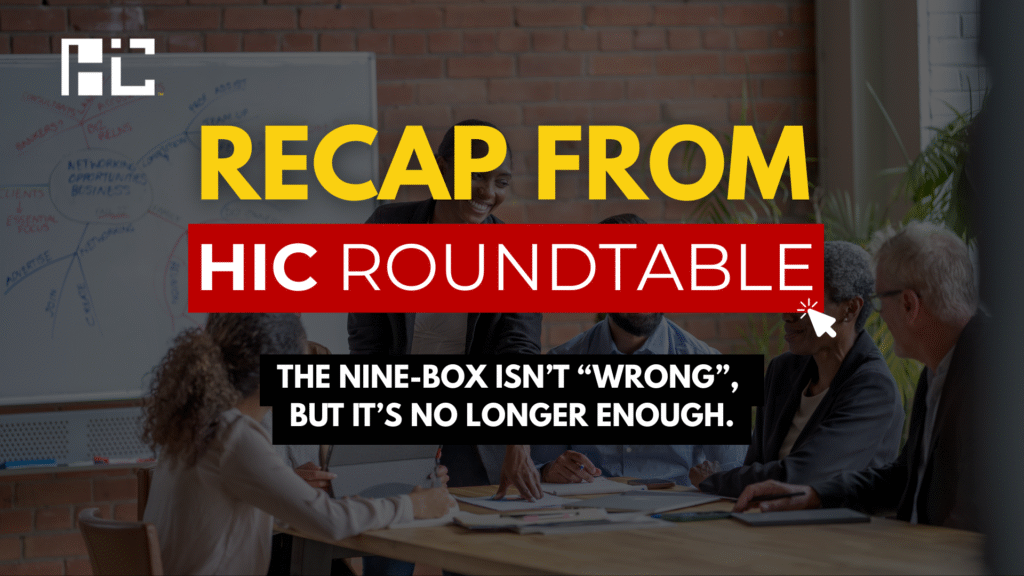

This week, HIC brought together senior HR and business leaders for a candid Executive Roundtable and one message came through loud and clear:
The way we evaluate talent is no longer keeping up with the way work actually works.
The Big Realization
Sara Patterson, Chief People Officer at Limble, was our guest speaker and she challenged one of HR’s most relied-on tools: the nine-box framework.
The consensus was it is too static.
Leaders shared how the model often:
Reduces complex, evolving humans into fixed labels
Creates false confidence in predicting “potential”
Fails to reflect how people actually grow, adapt, and deliver impact
As one leader put it: “We’re trying to forecast the future of people using outdated snapshots of their past.”
Where Traditional Talent Models Fall Short
Across industries from tech to operations, participants highlighted a common frustration:
Performance ≠ Potential. And neither guarantees impact.
In fast-moving environments, especially operational roles, talent gaps show up immediately in business outcomes. But in corporate settings, those same gaps can stay hidden for years.
Which raises the question:
Why are we still relying on systems that delay truth instead of reveal it?
What Forward-Thinking Leaders Are Doing Instead
Leaders are already experimenting with more modern, human-centered approaches:
Shifting from “performance & potential” → “performance & impact”
Replacing rigid boxes with dynamic personas and behavioral patterns
Focusing on skill-building over static role definitions
Reframing talent conversations around increasing business value, not just meeting expectations
One powerful takeaway:
Talent should be evaluated like a living system, not a fixed category.
The Generational Curveball
Interestingly, the group surfaced a tension many aren’t talking about:
While younger employees are digitally fluent, they’re not always more adaptable to change.
Leaders noted:
Increased desire for structure and clarity
Resistance to ambiguity and evolving expectations
Challenges navigating less-defined career paths
The future of work is about mindset agility and that’s a skill organizations must coach/train employees on.
Where This Leaves Us
The nine-box isn’t “wrong”, but it’s no longer enough.
What leaders need now are dynamic, context-rich ways to understand talent in real time:
How people think
How they solve problems
How they create value in changing environments
The biggest risk isn’t mislabeling talent, it’s underestimating it.
Ready to Rethink How Your Leaders Evaluate Talent?
At HIC , we don’t believe in one-size-fits-all training because your leaders aren’t one-size-fits-all.
We partner with organizations to customize and deliver immersive management and team trainings that meet leaders where they are, especially those in the most complex role in the business:
Leaders who manage leaders.
Our approach goes beyond theory. We equip your leadership layers to:
Navigate ambiguity and lead through change
Evaluate talent beyond outdated frameworks
Build high-performing teams that take full ownership
Drive measurable business impact through people
If you’re ready to move beyond static models and build leaders who can truly assess and elevate talent.
Let’s build it together.
Reply to this newsletter or reach out to learn more.
HIC will continue pushing this conversation forward in future roundtables because how we evaluate people will define how organizations grow.
Stay tuned.
About the Author
From securing an $8M breakthrough inside a global fintech to being named CEO of the very platform she built, Netta Jenkins has mastered the art of turning bold ideas into lasting business transformation. With a LinkedIn community of over 200,000, she’s the CEO redefining how organizations drive employee engagement and performance through AI. A two-time Wiley author, Netta’s work has been amplified by Arianna Huffington to more than 10 million people. Her latest book, Supercharged Teams: How Every Manager Can Create a Culture of Excellence, gives leaders the playbook to transform everyday teams into high-performing powerhouses.
As founder of HIC, a workplace consulting firm and creator of HIC HR Hub, a private community for senior HR leaders to share and gain new insights. She also hosts Beyond Management™, a viral LinkedIn leadership series with over 50 million impressions, where she sparks street-level conversations that elevate employer brands, attract top talent, and inspire customers. A seasoned TEDx and international keynote speaker, Netta has energized audiences across the U.S., Ghana, the Netherlands, and Turkey with bold insights and measurable takeaways. With 15+ years of global advisory experience, she shares weekly video tips that empower managers at every level. Her work has been featured in The Washington Post, McKinsey, Forbes, Fortune, and more. Named one of CIO Views’ Top 10 Most Influential Black Women in Business to Follow.
Netta helps organizations connect workplace culture, technology, and performance to deliver measurable, lasting impact. Previously serving as VP of Global Inclusive Strategy at IAC, Netta partnered with brands like Match.com, Vimeo, and Daily Beast. She advises Betterment, consults executives via the Intro app, and is pursuing a doctorate in quality systems. Currently, she collaborates with Marc Lore (former CEO of Walmart) and Preet Bharara (former U.S. Attorney for the Southern District of New York) to build Telosa, a visionary new city in America. Residing on the East Coast with her family, Netta continues to make a transformative impact in both the corporate and startup landscapes.