
Every week, a new AI tool promises to revolutionize work.
One writes emails. Another summarizes meetings. A third builds presentations in seconds.
So organizations rush to train employees on the tools.
Workshops. Certifications. Playbooks.
But there’s a problem: by the time employees finish the training, the tools they learned are already evolving.
The companies seeing real gains from AI aren’t focusing on tools at all.
They’re focusing on skills.
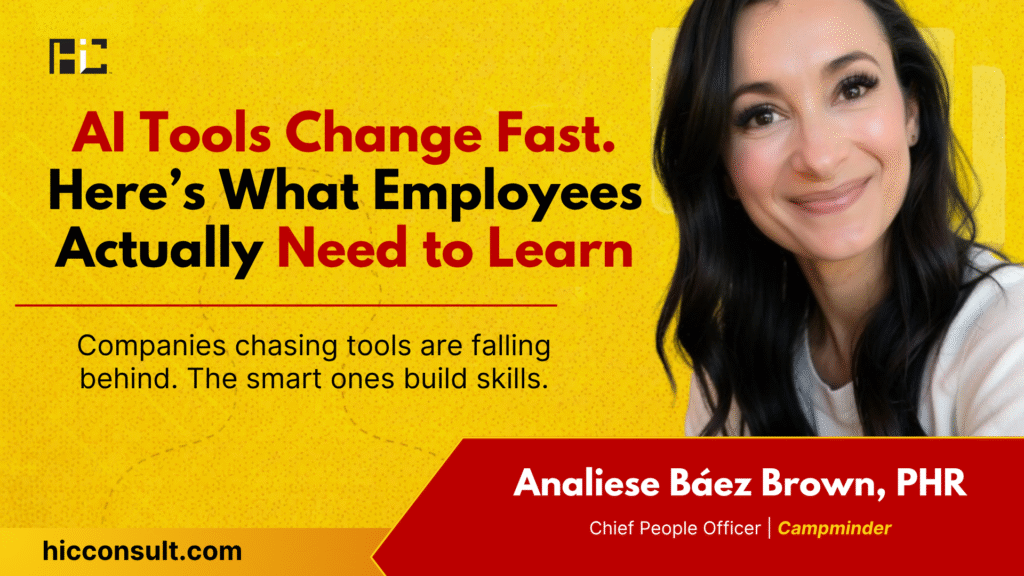
Analiese Báez Brown, Chief People Officer at Campminder, said many organizations misunderstand where the real value of AI adoption comes from.
“Many organizations start AI training by teaching employees specific tools,” Brown explained. “But tools change constantly. If the training is centered on the technology itself, the learning becomes outdated very quickly.”
Instead, she said, organizations should prioritize the human capabilities that allow employees to work effectively with AI regardless of the platform.
“The real unlock comes from building skills like problem framing, decision-making, and evaluating AI-generated work,” Brown said. “When employees develop those capabilities, they can apply them across any tool that emerges.”
Tool knowledge expires quickly
The pace of AI development makes tool-based training difficult to sustain.
According to the Stanford Institute for Human-Centered Artificial Intelligence, the number of notable AI models released globally has surged in recent years as companies race to introduce new systems and capabilities.
That rapid innovation means tools evolve faster than most training programs can keep up.
A course built around one platform today may feel outdated months later.
Teaching employees where to click inside a specific interface doesn’t prepare them for the next generation of AI systems.
Teaching them how to think with AI does.
One organization shifted its strategy
Brown said her own organization encountered this challenge early in its AI learning efforts.
Initial training programs focused on introducing employees to emerging tools and tactical use cases. But the approach quickly revealed its limitations.
“We realized quickly that focusing on tools wasn’t sustainable,” Brown said. “By the time people completed the training, the tools had already evolved.”
Instead, the organization is shifting toward a skills-based model for AI adoption.
The focus moves toward developing capabilities such as learning agility, problem scoping, and reviewing AI outputs critically.
“These are the capabilities that actually unlock value,” Brown explained. “If someone knows how to define the right problem and evaluate the output, they can work effectively with almost any AI system.”
The shift also changes how the company approaches AI support across teams.
In some cases, organizations are embedding AI expertise directly into functional groups to help rethink how work is structured.
“At Campminder, AI engineers are not just coding,” Brown said. “They are helping teams rethink how work gets done and where AI can create the most leverage.”
This was published on Inc.com first.

Click the Inc.com link to read the full article:
About the Author
From securing an $8M breakthrough inside a global fintech to being named CEO of the very platform she built, Netta Jenkins has mastered the art of turning bold ideas into lasting business transformation. With a LinkedIn community of over 200,000, she’s the CEO redefining how organizations drive employee engagement and performance through AI. A two-time Wiley author, Netta’s work has been amplified by Arianna Huffington to more than 10 million people. Her latest book, Supercharged Teams: How Every Manager Can Create a Culture of Excellence, gives leaders the playbook to transform everyday teams into high-performing powerhouses.
As founder of HIC, a workplace consulting firm and creator of HIC HR Hub, a private community for senior HR leaders to share and gain new insights. She also hosts Beyond Management™, a viral LinkedIn leadership series with over 50 million impressions, where she sparks street-level conversations that elevate employer brands, attract top talent, and inspire customers. A seasoned TEDx and international keynote speaker, Netta has energized audiences across the U.S., Ghana, the Netherlands, and Turkey with bold insights and measurable takeaways. With 15+ years of global advisory experience, she shares weekly video tips that empower managers at every level. Her work has been featured in The Washington Post, McKinsey, Forbes, Fortune, and more. Named one of CIO Views’ Top 10 Most Influential Black Women in Business to Follow.
Netta helps organizations connect workplace culture, technology, and performance to deliver measurable, lasting impact. Previously serving as VP of Global Inclusive Strategy at IAC, Netta partnered with brands like Match.com, Vimeo, and Daily Beast. She advises Betterment, consults executives via the Intro app, and is pursuing a doctorate in quality systems. Currently, she collaborates with Marc Lore (former CEO of Walmart) and Preet Bharara (former U.S. Attorney for the Southern District of New York) to build Telosa, a visionary new city in America. Residing on the East Coast with her family, Netta continues to make a transformative impact in both the corporate and startup landscapes.