
Economic headlines over the past year have been dominated by layoffs, automation, and uncertainty about the future of work.
Artificial intelligence is accelerating changes in the labor market, forcing millions of workers to reconsider what stability looks like in a career. According to a recent workforce survey conducted by the Harris Poll in partnership with the Business for Good Foundation, 75% of Americans said their definition of a “good job” has changed over the past five years.
At the same time, AI disruption is reshaping perceptions of job security. The survey also found that 76% of Americans believe trade jobs are less likely to be replaced by AI than white-collar roles, highlighting a growing shift toward skilled trades and hands-on careers.
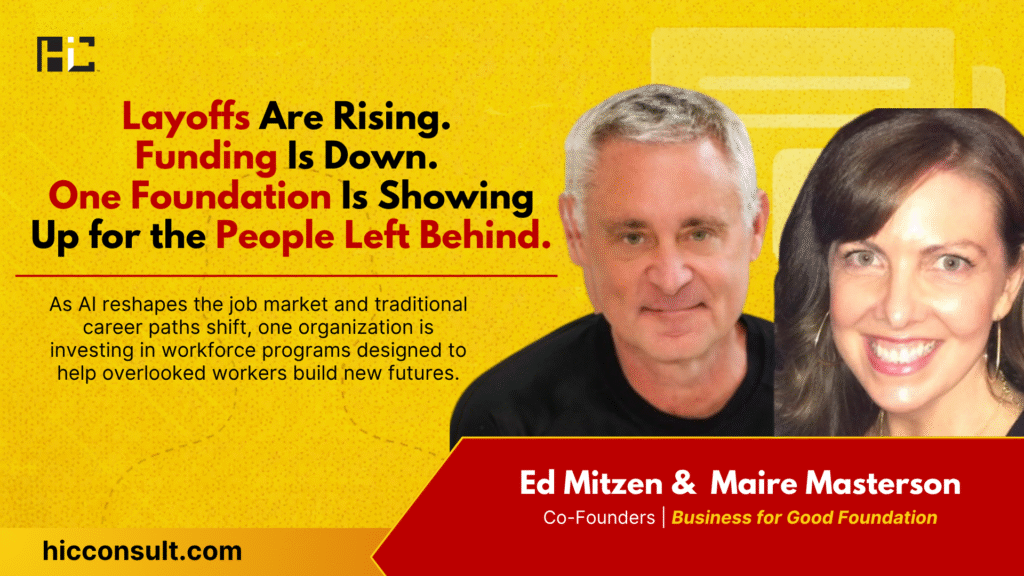
For Ed Mitzen, co-founder of the Business for Good Foundation, these changes are more than economic trends. They represent an urgent call to action.
“The people who feel overlooked in the economy are exactly the people we want to support,” Mitzen said.
The people often overlooked during economic change
Periods of economic disruption rarely affect everyone equally.
While executives and investors debate market trends, many workers are left navigating career uncertainty without clear pathways forward. Mid-level managers, recent college graduates, and workers displaced by automation are increasingly feeling the pressure.
Meanwhile, demand for skilled trades continues to grow.
The U.S. labor market currently faces significant shortages in technical and trade-based roles. For example, Ford Motor Company has reported thousands of open technician positions across the country as demand for skilled mechanics continues to outpace supply.
For many workers, these roles offer something that office-based work increasingly cannot: stability.
“Trade jobs are becoming more attractive because they offer strong wages and consistent demand,” Mitzen explained.
But access to those opportunities often requires training, mentorship, and support systems that many workers simply do not have.
That is where the Business for Good Foundation is focusing its efforts.
Workforce development as a community investment
The foundation operates around four pillars: workforce development, housing, economic stability, and support for small businesses.
This year, leaders decided to begin with workforce development.
Executive Director, Maire Masterson explained that the organization conducted extensive research before launching its first initiative. The team hosted roundtables with colleges, training programs, and workforce organizations to understand where the biggest gaps existed.
One insight became clear quickly.
Many workers do not fail because they lack intelligence or work ethic. They struggle because they lack access to the right training pathways and professional networks.
To address that gap, the foundation recently awarded a $25,000 workforce development grant to the SEAT Center, a nonprofit that helps individuals build career-ready skills through education, mentorship, and job placement programs.
The initiative is part of a broader $100,000 workforce commitment the foundation has earmarked to support individuals navigating career transitions in 2026.

This was published on Inc.com first.
About the Author
From securing an $8M breakthrough inside a global fintech to being named CEO of the very platform she built, Netta Jenkins has mastered the art of turning bold ideas into lasting business transformation. With a LinkedIn community of over 200,000, she’s the CEO redefining how organizations drive employee engagement and performance through AI. A two-time Wiley author, Netta’s work has been amplified by Arianna Huffington to more than 10 million people. Her latest book, Supercharged Teams: How Every Manager Can Create a Culture of Excellence, gives leaders the playbook to transform everyday teams into high-performing powerhouses.
As founder of HIC, a workplace consulting firm and creator of HIC HR Hub, a private community for senior HR leaders to share and gain new insights. She also hosts Beyond Management™, a viral LinkedIn leadership series with over 50 million impressions, where she sparks street-level conversations that elevate employer brands, attract top talent, and inspire customers. A seasoned TEDx and international keynote speaker, Netta has energized audiences across the U.S., Ghana, the Netherlands, and Turkey with bold insights and measurable takeaways. With 15+ years of global advisory experience, she shares weekly video tips that empower managers at every level. Her work has been featured in The Washington Post, McKinsey, Forbes, Fortune, and more. Named one of CIO Views’ Top 10 Most Influential Black Women in Business to Follow.
Netta helps organizations connect workplace culture, technology, and performance to deliver measurable, lasting impact. Previously serving as VP of Global Inclusive Strategy at IAC, Netta partnered with brands like Match.com, Vimeo, and Daily Beast. She advises Betterment, consults executives via the Intro app, and is pursuing a doctorate in quality systems. Currently, she collaborates with Marc Lore (former CEO of Walmart) and Preet Bharara (former U.S. Attorney for the Southern District of New York) to build Telosa, a visionary new city in America. Residing on the East Coast with her family, Netta continues to make a transformative impact in both the corporate and startup landscapes.