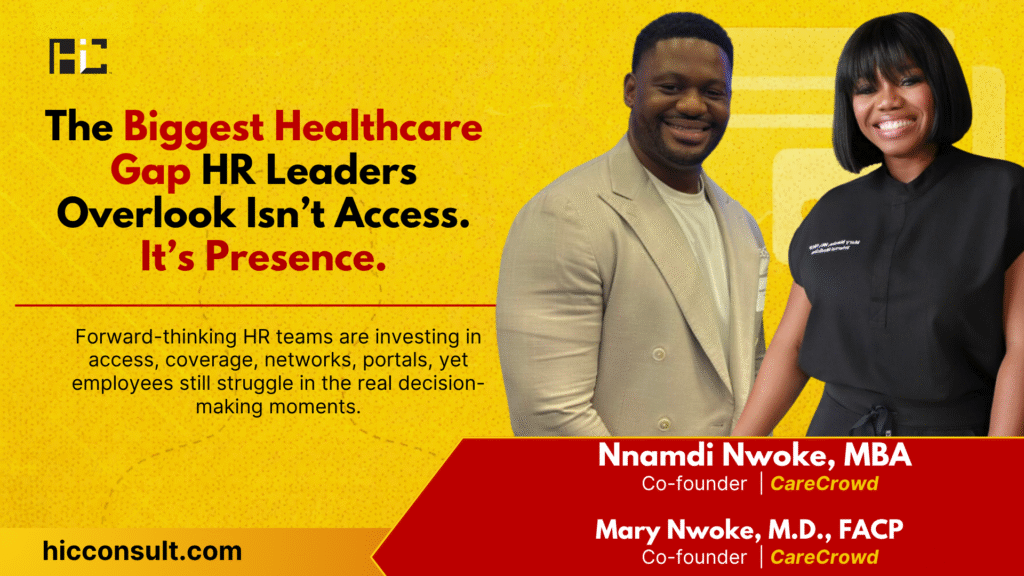

Forward-thinking HR teams are investing in access, coverage, networks, portals, yet employees still struggle in the real decision-making moments.
HR leaders have done the work.
They negotiate competitive health plans. They expand networks. They add mental health platforms, telehealth access, and navigation tools. And yet, employees are still overwhelmed in the moments that matter most: after the diagnosis, between appointments, when specialists disagree, or when a spouse is navigating cancer and no one knows what to do next.
The real gap isn’t access. It’s presence.
In my interview with Dr. Mary Nwoke and Nnamdi Nwoke, co-founders of CareCrowd, they identified what they call the “presence gap”, the absence of continuous physician guidance between appointments.
“Healthcare doesn’t fail because people lack insurance,” Nnamdi said. “It fails because people are left alone in the most critical decision-making moments.”
Health insurance doesn’t solve confusion
According to the Kaiser Family Foundation, nearly half of insured adults report difficulty understanding their coverage and out-of-pocket costs. Access exists. Clarity does not.
Chief Human Resource Officer, Lori Almeida, Esq. of Allison Worldwide shared a story that perfectly illustrates what so many families experience:
“My daughter had a medical situation which took us to many doctors for a diagnosis. Every doctor seemed to offer a piece of the puzzle, but no one looked at her situation holistically. I needed someone to help me connect the dots. I finally found that doctor who was spot on with the diagnosis and treated her whole self. She looped in experts in each area and was the center of her medical team. Had we not found this doctor, I would still be trying to figure out what was wrong.”
Even as a senior HR executive with healthcare coverage for her daughter, Lori found herself navigating a fragmented system, piecing together conflicting medical opinions, searching for someone who could step back and see the full picture.
Eboni Lee, Head of Human Resources at Haypp Group shared how she spent weeks helping an employee whose wife had cancer navigate short-term disability, specialist referrals, and supplemental coverage options. The insurance technically worked. But the stress of coordinating care, interpreting conflicting advice, and advocating for the right treatment left the employee severely overwhelmed.
Eboni also shared her personal experience of being misdiagnosed multiple times before finally receiving proper testing. “It shouldn’t require that level of persistence,” she said.
“Employees don’t need more portals. They need guidance.” she said.
That’s the presence gap.
This was published on Inc.com first.
Click the Inc.com link to read the full article: https://www.inc.com/netta-jenkins/the-biggest-healthcare-gap-hr-leaders-overlook-isnt-access-its-support/91319825
About the Author
From securing an $8M breakthrough inside a global fintech to being named CEO of the very platform she built, Netta Jenkins has mastered the art of turning bold ideas into lasting business transformation. With a LinkedIn community of over 200,000, she’s the CEO redefining how organizations drive employee engagement and performance through AI. A two-time Wiley author, Netta’s work has been amplified by Arianna Huffington to more than 10 million people. Her latest book, Supercharged Teams: How Every Manager Can Create a Culture of Excellence, gives leaders the playbook to transform everyday teams into high-performing powerhouses.
As founder of HIC, a workplace consulting firm and creator of HIC HR Hub, a private community for senior HR leaders to share and gain new insights. She also hosts Beyond Management™, a viral LinkedIn leadership series with over 50 million impressions, where she sparks street-level conversations that elevate employer brands, attract top talent, and inspire customers. A seasoned TEDx and international keynote speaker, Netta has energized audiences across the U.S., Ghana, the Netherlands, and Turkey with bold insights and measurable takeaways. With 15+ years of global advisory experience, she shares weekly video tips that empower managers at every level. Her work has been featured in The Washington Post, McKinsey, Forbes, Fortune, and more. Named one of CIO Views’ Top 10 Most Influential Black Women in Business to Follow.
Netta helps organizations connect workplace culture, technology, and performance to deliver measurable, lasting impact. Previously serving as VP of Global Inclusive Strategy at IAC, Netta partnered with brands like Match.com, Vimeo, and Daily Beast. She advises Betterment, consults executives via the Intro app, and is pursuing a doctorate in quality systems. Currently, she collaborates with Marc Lore (former CEO of Walmart) and Preet Bharara (former U.S. Attorney for the Southern District of New York) to build Telosa, a visionary new city in America. Residing on the East Coast with her family, Netta continues to make a transformative impact in both the corporate and startup landscapes.